Set up rule mining
Before you start
For an Active Directory target system, Configure correlation.
For a PowerShell v2 target system, Configure correlation and Configure import from target system.
On the Provisioning dashboard, go to Business > Rule mining.
Click the
 Settings button.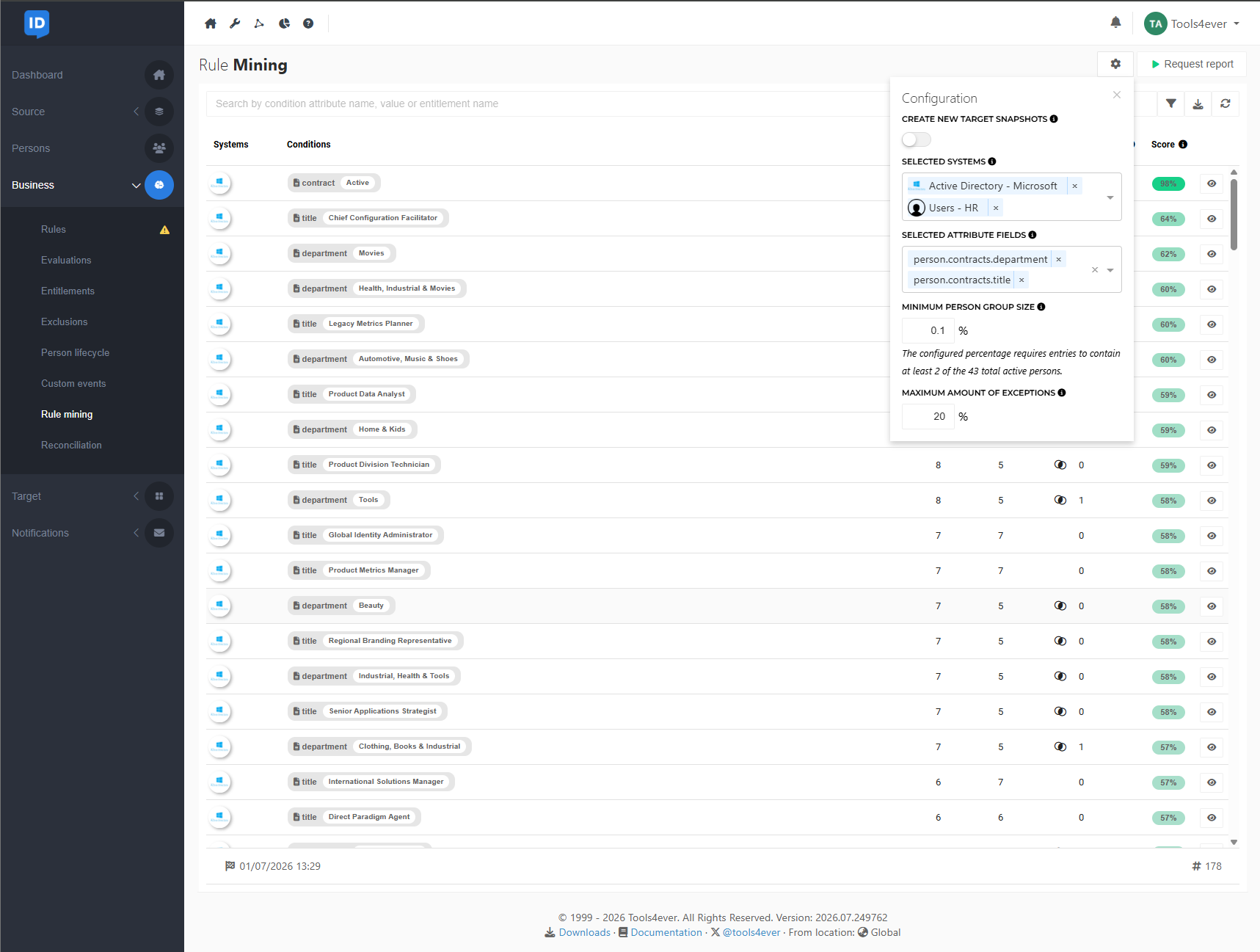
Use the Selected systems dropdown to select the target systems (maximum: 10) to include in the report.
From the Selected attribute fields dropdown, select at most 5 Person schema and/or Contract schema fields (for example:
person.contracts.departmentandperson.contracts.title). Only selected fields will be used when comparing source data of persons with an active contract.Of the following fields, the ExternalID or Code is used in comparisons, and the Name, DisplayName or Description is displayed in the Rule mining report.
Field
Compared by
Displayed
Person field: Location
Contract fields: Division, CostBearer, Costcenter, Employer, Location, Organization, Team, Title
ExternalID
Name
Contract field: Department
ExternalID
DisplayName
Contract field: Type
Code
Description
A rule mining report lists conditions (or condition sets) that apply to groups in which most persons share common Entitlements in a target system.
A condition is included only if the corresponding group is large enough, according to your settings.
Use Minimum person group size to define the minimum group size as a percentage of all active persons who meet the same condition. You can enter a percentage with one decimal place (for example, 10.5).
The calculated minimum number of persons is displayed below the setting. This value is always at least 2 and is rounded up to the nearest whole number.
A condition is included in the report only if enough persons in the group share at least one entitlement.
Use Maximum amount of exceptions to define the maximum percentage of group members who may not have a specific entitlement. Enter a value between 0% and 20%.
Entitlements whose unassigned percentage exceeds the Maximum amount of exceptions threshold are excluded from the condition. If all entitlements are excluded, the condition is not included in the report.
Tip
A higher value includes entitlements that are not assigned to every person in the group. For example, with a value of 20%, entitlements assigned to more than 80% of the persons within a condition scope will be reported as common. In organizations with unevenly sized subgroups this may cause rule mining recommendations to include entitlements that are primarily associated with a large subgroup.
A lower value makes the results more restrictive. Setting the value to 0% ensures that only entitlements assigned to every person within the condition scope are included in the report. This can be particularly useful when creating an initial set of business rules.
You can now Create a rule mining report.