Rule mining report
A rule mining report lists conditions (or condition sets) that apply to groups in which most persons share common Entitlements in a target system.
A condition is listed only if the group meets the minimum group size and if there are not too many exceptions to the rule. These limits are configured when you Set up rule mining.
Conditions are ranked by how efficiently they identify persons with the same entitlement(s) across one or more target systems. This helps create the smallest and most efficient set of Business rules.
To view a rule mining report, go to Business > Rule mining. If there is no report yet, Create a rule mining report.
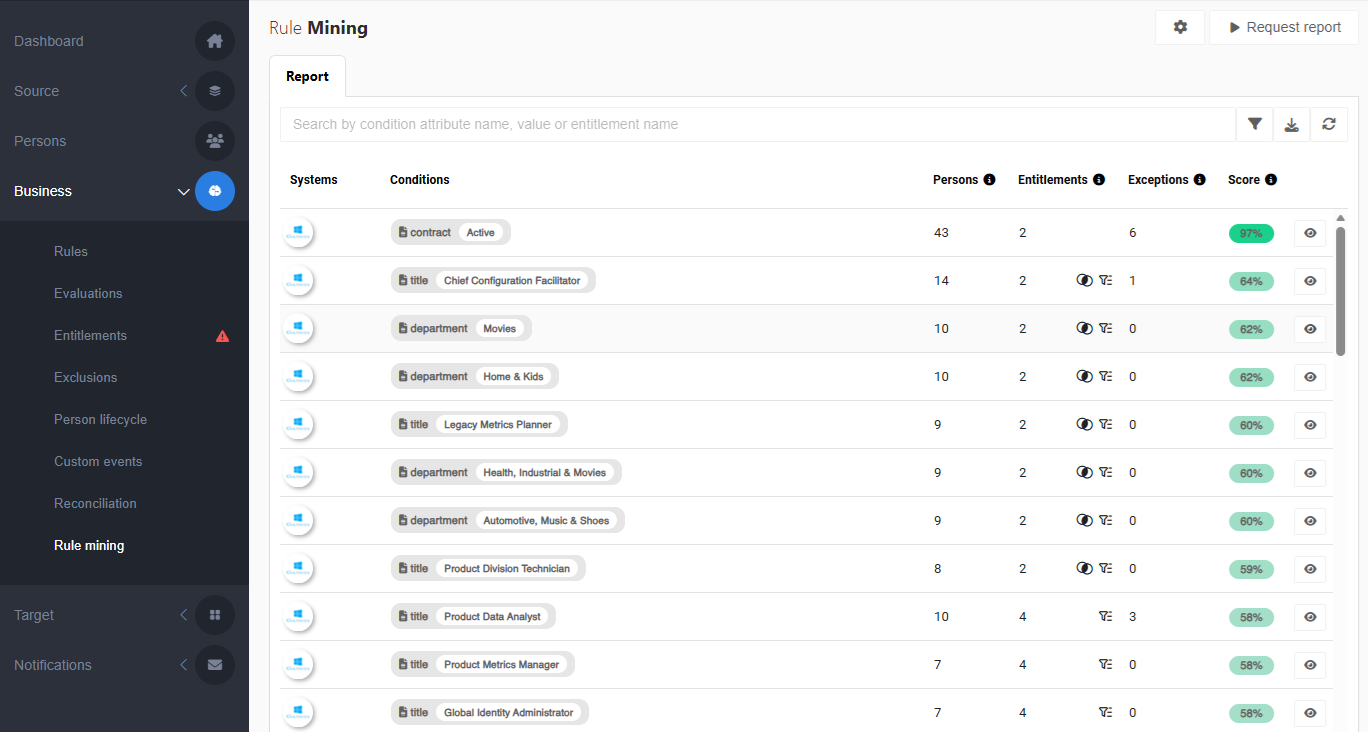
Columns
System: The target system or systems in which the persons who meet the condition share the same entitlement(s).
Conditions: Each row has one or more Person schema and/or Contract schema fields and values that can be used as condition (or condition set) in a business rule.
Use the search bar at the top to find a condition by attribute name, value, or entitlement name.
If the screen isn’t wide enough to display all conditions in a set, an indicator shows how many additional conditions are hidden.
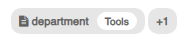
Hover over the indicator to view all conditions.
If the value is a name (like 'Tools' in the above image), hover over it to see the ID or code that was used in the comparison.
Note
Conditions in a condition set are combined with AND.
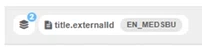
If the same group of persons can be identified by different condition sets, an icon at the start of the line shows how many condition sets result in the same group.
Click
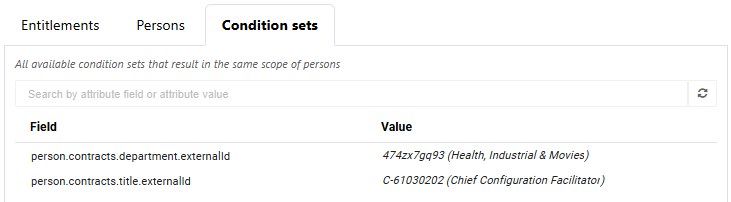
 Details, then open the Condition sets tab to view the equivalent condition sets and select which one to display in the report.
If you search for a value that appears only in an alternative condition (or condition set) that isn’t shown, the report will automatically display that alternative condition.
Persons: The number of persons that meet the condition.
Entitlements: This column shows the total count of entitlements common to all persons who meet the condition. For example, if these persons have an Active Directory account and access to that account, the number shown is 2.
Icons in this column indicate overlap:
 Potentially redundant: All of the entitlements covered by this condition (set) could be granted by a condition with a higher ranking.
 Covered by configured rules: An existing business rule can grant the same entitlements to the same group of persons. The business rule may be in draft or published state.
Tip
Use the
 Filter options to hide conditions that overlap with higher-ranked conditions and/or with current business rules.
Exceptions: The number of missing entitlements for persons who meet the condition. If the condition were used in a business rule, this number of entitlements would be granted to persons in scope of the condition who do not currently have the entitlements.
Score: A percentage that indicates how efficient this condition identifies persons who have the same entitlements in one or more target systems. The score is calculated from the group size and the number of exceptions.
Details per condition
Click  Show details to get more detailed information about a condition, divided over 3 tabs: Entitlements, Persons, and Condition sets.
All of these tabs have a search bar that you can use to find a specific entitlement, person or condition.
Entitlements: The entitlements that at least 80% of the identified group of people have in common.
Per entitlement, you can see how many persons in the group do not currently have it. Click
Show details to view who they are.Click
Filter to include or exclude entitlements based on the target system or whether they are potentially redundant (entitlements that can be granted via a higher ranked condition).
Persons: All persons identified by the condition (or condition set). Persons who do not currently possess one or more of the entitlements common to this group are listed first.
Click
Show details to view which entitlements a person currently misses. Use the search bar to find specific entitlements.
Condition sets: The conditions or condition sets that identify the group of persons.